
The ENCALS Meeting 2026 — the annual congress of the European Network to Cure ALS — was held in Madrid (24–26 June 2026; Palacio Municipal de IFEMA MADRID), organised with the Fundación Luzón and drawing more than 880 researchers and clinicians from 45 countries. On behalf of the ALS/MND Unit at Bellvitge University Hospital, my participation spanned an oral communication, three posters and moderating one of the scientific sessions.
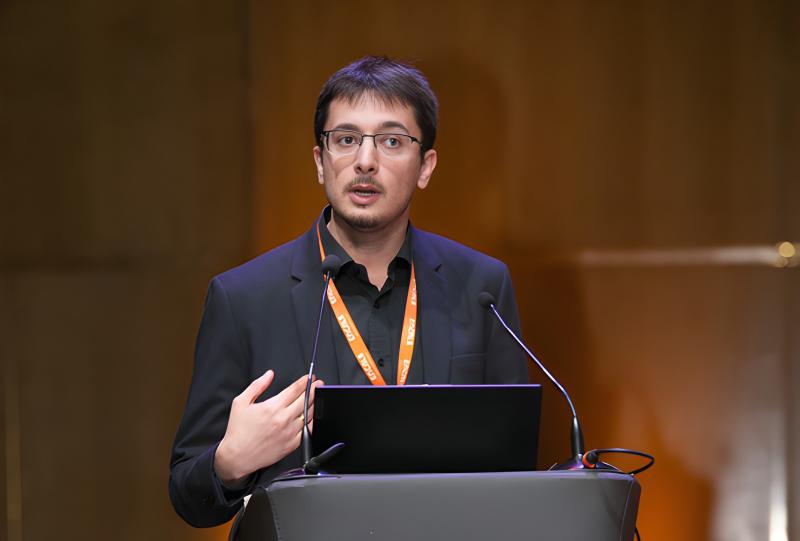
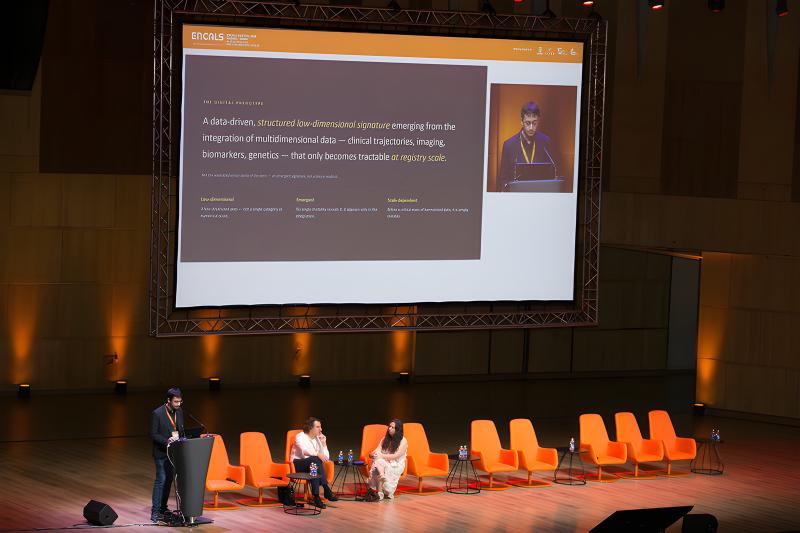
Oral communication — From Registries to Digital Phenotypes#
Given in the session on Data, Platforms and Artificial Intelligence, the talk traced an argument that runs through much of the rest of my work at the meeting. The phenotype of ALS has never been fixed: it has widened every time the field acquired a new way to measure the disease — from Charcot’s motor definition, to the ALS–FTD spectrum opened by TDP-43 and C9orf72, to the data-driven subgroups now emerging from imaging, EEG and the clinical record. The disease did not change; our resolution did.
That expansion is now bottlenecked less by ideas than by data. Registries — uniquely — reach for both phenotyping depth and population representativeness at once, which is why they, rather than trials, are becoming the field’s discovery engines. Against that backdrop the talk set out the idea of a digital phenotype: not the wearable-sensor sense of the term, but a data-driven, low-dimensional signature that is emergent (no single modality reveals it) and scale-dependent (below a critical mass of harmonised data it is simply invisible). At the scale of a platform like PRECISION ALS (24,000+ harmonised patients), such phenotypes enable prediction and stratification, better disease modelling and trial design, and even synthetic, shareable trajectories with no real patient in them. The closing note: three forces — a harmonised pan-European data platform, mature machine learning for clinical trajectories, and a decade of trial failures attributed to unmodelled heterogeneity — have converged, and ALS, with its quantitative endpoint and strong European registry culture, is where the next generation of deep phenotyping is being built.
Posters#
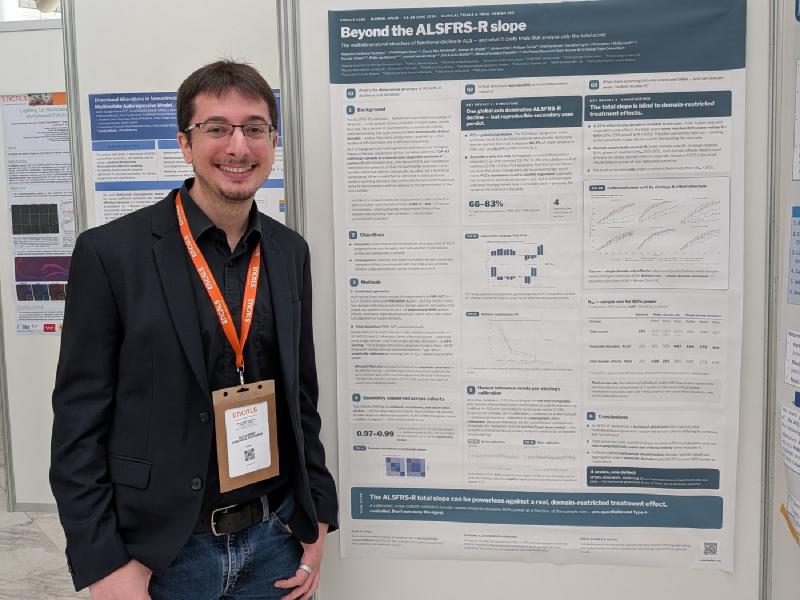
Beyond the ALSFRS-R slope#
The ALSFRS-R total slope — twelve items summed into a single 0–48 score — is the default primary endpoint in nearly every pivotal ALS trial, yet the scale measures four anatomically distinct domains that decline at different rates. Fitting multivariate mixed models independently to PRO-ACT and PRECISION ALS (~16,000 patients across two continents), the slope eigenstructure is near-identical across cohorts (cosine similarity 0.97–0.99, PC1–PC4): one global progression axis dominates (66–83% of slope variance), but reproducible secondary axes — respiratory-vs-limb, bulbar-vs-limb, fine-vs-gross motor — persist as stable properties of the disease rather than artefacts of selection. In trial simulations, a real 25% effect confined to one domain is nearly invisible to the total slope (< 21% power at N = 600), whereas calibrated, domain-aware models recover it at N ≈ 250–428 — the same patients, the same effect.
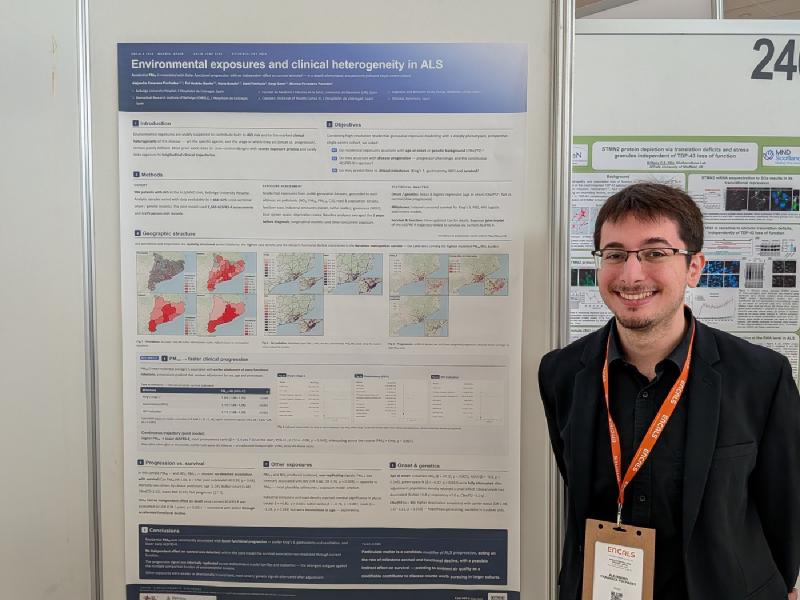
Environmental exposures and clinical heterogeneity in ALS#
Combining high-resolution residential geospatial exposure modelling with the deeply phenotyped Bellvitge cohort (986 patients with ALS), residential PM₁₀ (5-year pre-diagnosis average) was consistently associated with earlier attainment of every functional milestone — King’s stage 3, gastrostomy and non-invasive ventilation — and with lower early ALSFRS-R, a signal internally replicated across independent model families. No independent effect on survival was detected; within a Bayesian joint model the survival association was mediated through current function. Particulate matter thus emerges as a candidate modifier of ALS progression and a modifiable contributor to disease course worth pursuing in larger cohorts.
Dissociation between functional decline and quality of life#
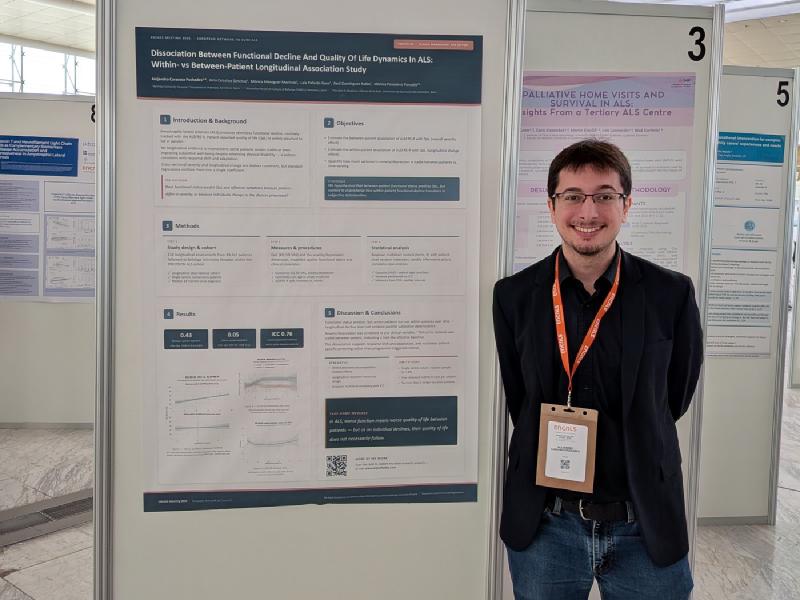
ALS produces relentless functional decline, and quality of life (QoL) is widely assumed to fall in parallel — but cross-sectional severity and longitudinal change are distinct constructs that standard regressions conflate. Using Bayesian multilevel models on 116 longitudinal assessments from 83 patients (Bellvitge / PRECISION ALS cohort) with an explicit within- vs between-patient decomposition, functional status predicted QoL across patients (β ≈ 0.43) but not within patients over time (β ≈ 0.05): as an individual declines, their quality of life does not necessarily follow. Anxiety/depression was unrelated to any clinical variable and largely trait-like (ICC ≈ 0.76) — a dissociation consistent with response shift and adaptation, and an argument for patient-specific screening rather than progression-triggered referral.
Moderating — Epidemiology & Phenotyping#
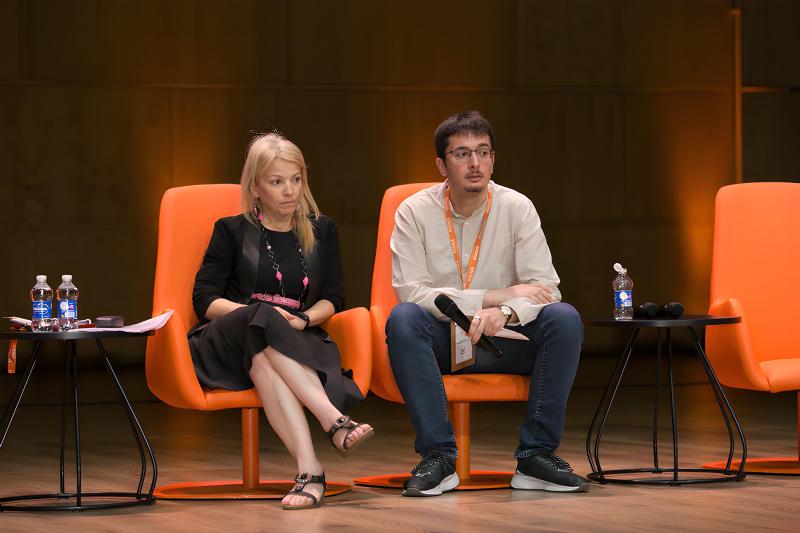
I also moderated the Epidemiology & Phenotyping session — a theme shared by the three posters and the oral communication, which all turn on the same problem: how to read structure out of the clinical record at scale.
The 2026 edition also featured a plenary lecture by Mònica Povedano, director of the ALS/MND Unit at Bellvitge, on ALS in a changing world — environment, climate and neurodegeneration — a theme that dovetails directly with the air-pollution poster above. Bringing the ENCALS Meeting to Madrid, and the prominent role of Spanish registries and cohorts in its programme, reflects how central harmonised, population-scale data has become to ALS research.