
I took a poster to the ENCALS Meeting 2024 (Stockholm, Sweden, 17–20 June 2024; Aula Medica, Karolinska Institutet), on the two functional scales our patients fill in on their phones. The days before it were spent with the PRECISION ALS consortium, which held its meeting on 16 June and a machine-learning workshop on the morning of the 17th, before the ENCALS programme opened.
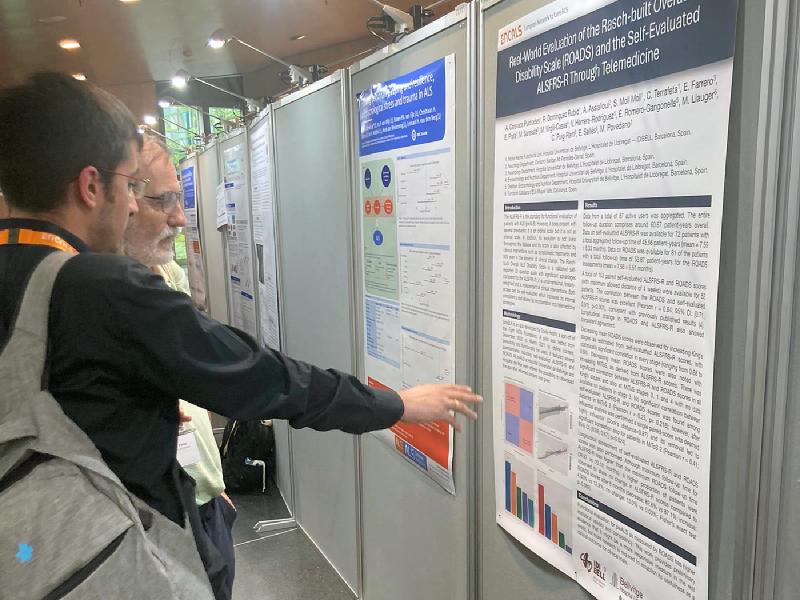
Poster — ROADS and the self-evaluated ALSFRS-R through telemedicine#
The ALSFRS-R is how we all measure function in ALS, and it is the endpoint on which trials are won or lost — but it is a strange ruler. It is ordinal without being an interval scale, so the distance between 2 and 3 is not the distance between 3 and 4; its decline is curvilinear rather than straight; and its score moves when we intervene — a gastrostomy, non-invasive ventilation, a symptomatic treatment — even when the patient has not changed. The Rasch-built Overall ALS Disability Scale (ROADS) was built to avoid exactly these problems: 28 self-reported questions, unidimensional, linearly weighted, and independent of clinical interventions. Both scales can be scored by the patient rather than the clinician, which is what makes them usable at a distance — and gave me a way to compare them in the real world rather than in a trial.
The data came from LinkELA, the app built by Doole Health that we use to follow our patients from home, and whose first analysis was the poster I took to Basel the year before. Every person with ALS at Bellvitge University Hospital and Hospital del Mar was offered the app, and those who consented answered both scales on the same schedule. That gave me 87 active users and about 60.7 patient-years of follow-up — 72 patients with self-evaluated ALSFRS-R and 81 with ROADS. What I asked of it:
- Do the two scales agree? Across 153 paired scores from 52 patients, taken no more than four weeks apart, the correlation was excellent (Pearson r = 0.84; 95% CI 0.71–0.91), and their longitudinal change agreed too. Patients scoring themselves at home reproduce, on ROADS, essentially what the ALSFRS-R says about them.
- Does the agreement survive the course of the disease? Mean ROADS fell as King’s and MiToS stages rose, as it should, and the two scales stayed significantly correlated at every King’s stage (r = 0.68–0.84). The one exception was MiToS 2, where the correlation vanished (r = 0.23) — until an influence analysis singled out one paired score (Cook’s distance 0.87) whose removal restored it (r = 0.41; 95% CI 0.06–0.67). A scale that agrees only in early disease would be of little use; this one did not fail that way.
- Which scale notices that a patient has moved? This was the result I had not expected to matter most. Over six months, 13% of patients showed no change at all on the ALSFRS-R, and none were unchanged on ROADS (Fisher’s exact p = 0.082 — a signal, not yet a finding). The ALSFRS-R has a floor of resolution below which a patient is declining and the score says nothing; ROADS, on this evidence, kept measuring.
The conclusion I drew was deliberately narrow: ROADS is the more statistically defensible instrument, and this is preliminary real-world evidence that it may also be the more responsive one — but it is 52 patients, and the responsiveness result did not reach significance. What it does say is that the scale we most want in trials is the one we could already be collecting from patients at home.
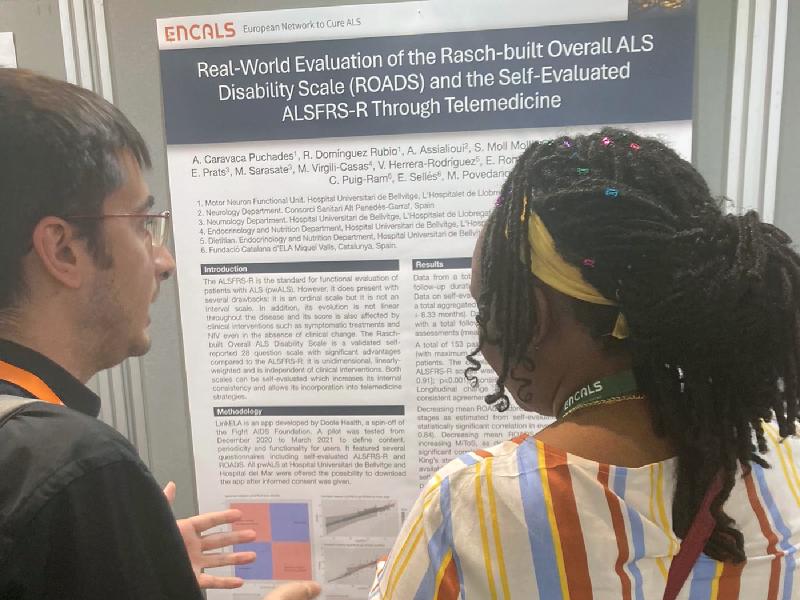
The work was done with the ALS/MND Unit at Bellvitge University Hospital and the Fundació Catalana d’ELA Miquel Valls, together with Raúl Domínguez Rubio, Abdel Assialioui, Sara Moll, Cristina Terrafeta, Eva Farrero, Enric Prats, Mikel Sarasate, M. Núria Virgili-Casas, Verónica Herrera-Rodríguez, Elisabet Romero-Gangonells, Marta Llauger, Cristina Puig-Ram, Esther Sellés and Mònica Povedano Panadés.
The ENCALS Meeting is the annual conference of the European Network to Cure ALS; the 2024 edition was hosted by Karolinska Institutet in the Aula Medica, a thousand-seat pillar-free amphitheatre on its Solna campus, and ran for four days of plenaries, platform sessions and posters on ALS genetics, biomarkers, clinical trials and care.