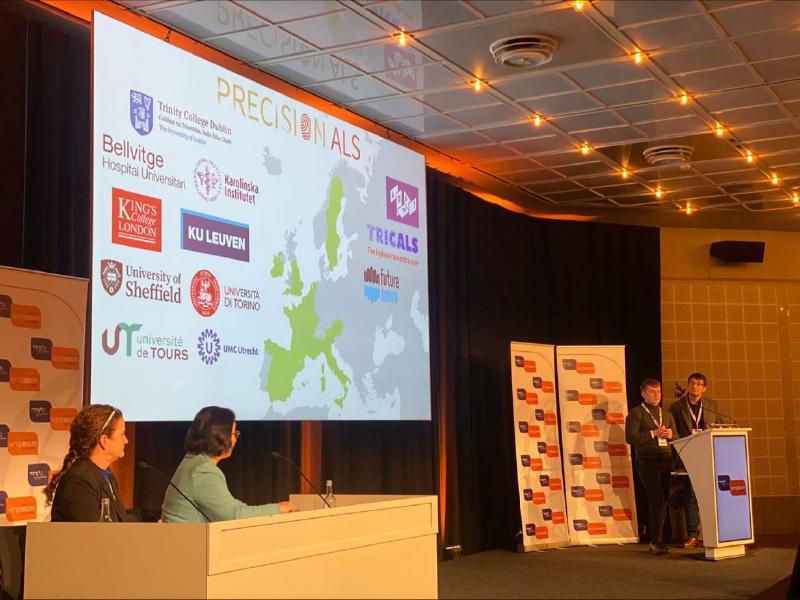
I took two things to the 34th International Symposium on ALS/MND (Basel, Switzerland, 6–8 December 2023; Congress Center Basel), organised by the Motor Neurone Disease Association: a platform communication in the Improving Clinical Practice session, which I presented together with Harry McDonough (Sheffield Institute for Translational Neuroscience), and a poster on the telemedicine programme we run at the ALS/MND Unit of Bellvitge University Hospital.
Platform communication — Mapping the natural history of ALS#
"Mapping the natural history of amyotrophic lateral sclerosis: time-to-event analysis of clinical milestones in the pan-European, population-based PRECISION-ALS cohort" was our answer to a simple question: what can we see about this disease that no single centre can see alone? We pooled extant records from nine sites in eight European countries — the PRECISION ALS platform — and harmonised them into one population-based cohort of 21,547 people with ALS, primary lateral sclerosis or progressive muscular atrophy. Then we mapped the milestones that actually structure a patient’s life with the disease — symptom onset, diagnosis, needing help to walk, the first respiratory symptoms, vital capacity dropping below 80% of predicted, starting non-invasive ventilation, gastrostomy, King’s and MiToS stages, and death — stratifying by age, sex, site of onset, phenotype, genotype, cohort and rate of progression.
- Onset, delay and survival. Our patients’ median age at symptom onset was 64.5 years, earlier in those carrying FUS; they waited almost exactly a year from onset to diagnosis, and survived a median of 2.83 years from onset — less if they were women, and least of all with C9orf72 or FUS, against the far longer survival we saw with TARDBP or SOD1.
- Progression rate orders everything. Time to each King’s and MiToS stage, to vital-capacity decline and to death all followed the ALSFRS-R progression rate at diagnosis: fast progressors reached every milestone sooner than intermediate and slow ones. The disease runs on its own clock, and the slope we measure at diagnosis largely tells us how fast that clock is ticking.
- The finding that was not about the disease. Time to gastrostomy and time to non-invasive ventilation differed significantly between cohorts — that is, between our own centres. Bulbar-onset and C9orf72-positive patients got their gastrostomy sooner, which is what we would expect; but we also started non-invasive ventilation at different vital capacities depending on where the patient happened to be treated. That is the part I found hardest to look away from: some of what we read as the course of the disease is us.
Which is why I think this pooling is worth the work it costs. With one registry I see my own practice; with nine, I can begin to tell which part of a patient’s trajectory is the illness and which part is the health system treating it.
Poster — LinkELA: an ALS telemedicine project in Barcelona#
My poster brought the first analysis of LinkELA, the patient-centred app owned by the Fundació Catalana d’ELA Miquel Valls and built by Doole Health that lets us carry multidisciplinary follow-up into the patient’s home. Our patients fill in four questionnaires — respiratory symptoms, ALSFRS-R, ROADS and EAT-10 — every month or quarter; the app colour-codes what they report and raises an alarm when something changes, so that we can watch nutrition, ventilation, mobility and mood between visits instead of only during them.
Since we launched it in March 2022, 48 of our patients at Bellvitge had registered, they had returned 1,911 questionnaires, and the alarm system had fired 546 times. The result I most wanted to know was the agreement between the ALSFRS-R our patients score on themselves at home and the one we score in clinic: intraclass correlation was high overall and held across sex, age group and King’s stage. This shows that patients and clinicians measure functional status in much the same way. Telemedicine, on this first evidence, is something our patients accept as a complementary way of being followed — though we need a larger sample and longer follow-up before I would say more than that.
The work was done with the ALS/MND Unit at Bellvitge University Hospital and the Fundació Catalana d’ELA Miquel Valls, together with Marta Llauger, Cristina Puig-Ram, Esther Sellés, Raúl Domínguez Rubio, Abdel Assialioui, Eva Farrero, Enric Prats, M. Núria Virgili-Casas, Verónica Herrera-Rodríguez, Elisabet Romero-Gangonells and Mònica Povedano Panadés.
The International Symposium on ALS/MND is the largest annual meeting devoted to the disease, gathering biomedical researchers, clinicians and allied health professionals from across the world; the 2023 edition was hosted in Basel by Verein ALS Schweiz.